

Prefer listening? Play the audio version of this article.
Table Of Contents
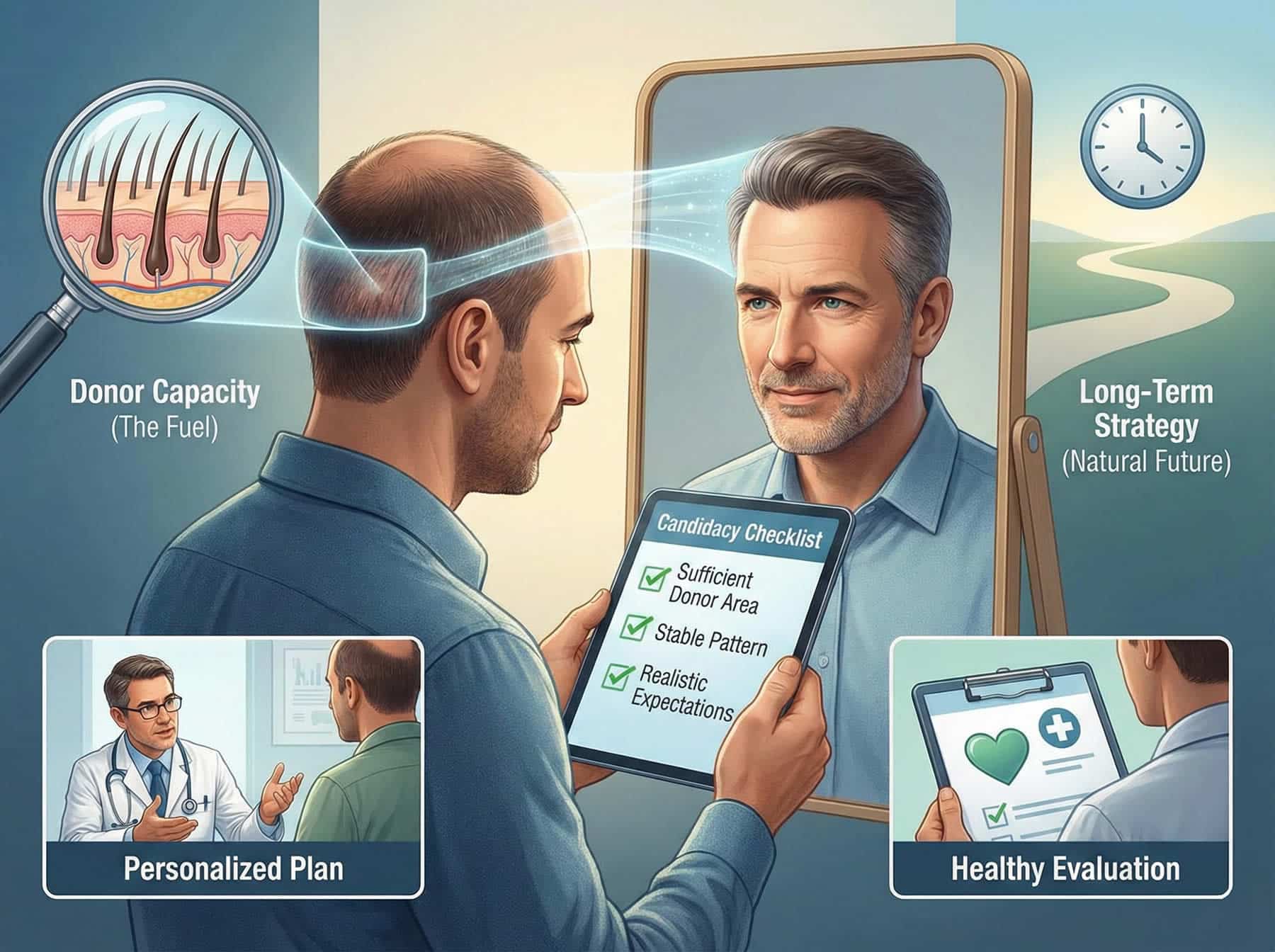
A hair transplant can be a highly effective solution for people who have the right type of hair loss, a strong donor area, and a realistic understanding of what the procedure can and cannot achieve. The core principle is simple: a hair transplant redistributes your existing, healthy follicles from denser areas to thinner areas. It does not create unlimited new hair. Therefore, candidacy is determined by donor capacity, proper planning, and a long term strategy.
Below, you will find a clear breakdown of who is typically a good candidate, when waiting may be the smarter option, and what a healthy evaluation process should include.
Quick candidacy checklist
If most of the following apply to you, you are generally a good candidate:
You have sufficient, healthy donor hair
Typically, the back and sides of the scalp have a donor density that can be harvested safely and transplanted without leaving visible thinning.Your hair loss follows a transplant suitable pattern
The most common examples are male and female pattern genetic hair loss (androgenetic alopecia).You are in good overall health and can safely undergo a minor surgical procedure
Your expectations are realistic
Density, hairline design, and coverage goals should be set according to donor capacity and the size of the balding area.Hair loss is stable or reasonably predictable
This allows the design to remain natural over time. In some cases, medical treatment first and surgery later can be the more appropriate approach.
If some of these points are uncertain, you may still be a candidate, but a more detailed analysis and a more personalized plan will likely be necessary.
What does being a “good candidate” mean in practice?
A hair transplant involves moving hair follicles from one area of the scalp to another area where hair is thinning or has been lost. A successful outcome is not determined only by how many grafts are transplanted, but by the following factors:
Donor capacity: how many follicles can be harvested without weakening the donor area
Recipient area needs: the size of the area to be covered and the desired density
Hair characteristics: thickness, curl pattern, and color contrast all influence the perception of fullness
Progression risk: whether the existing non transplanted hair may continue to thin over time
A good clinic evaluates candidacy with planning discipline, not with a sales mindset.
Who is generally suitable for a hair transplant?
1) People with genetic pattern hair loss
The most common and most successful hair transplant cases involve pattern hair loss (androgenetic alopecia). In men, this often appears as temple recession, crown thinning, and diffuse thinning on the top. In women, it may present more as widespread thinning in the top area.
This matters because a predictable pattern allows for a hairline and distribution design that can remain natural in the future.
2) People with an adequate donor area
The donor area is the “fuel” of a transplant. If donor density is insufficient, the desired density may not be achievable regardless of how advanced the technique is. In good candidates, the donor can be planned in a way that still looks natural after harvesting.
3) People with realistic expectations and a long term mindset
A hair transplant can deliver a natural and strong appearance, but in patients with extensive baldness, it is not always possible to provide maximum density everywhere. Successful candidates understand that:
The goal should be an age appropriate, natural appearance.
The donor supply is limited, and giving the same density to every zone is not always the best strategy.
In some cases, a second session can be part of the right plan.
4) Men and women with an accurate diagnosis
With the right diagnosis and a strong donor area, hair transplantation can be performed in both men and women. In women, diagnosis is especially critical because hair loss patterns can be more variable, and candidacy must be assessed more carefully in some diffuse thinning cases.
Situations where additional evaluation is needed, but transplantation may still be possible
Being young and actively losing hair
If hair loss is progressing rapidly, especially in the early 20s, many physicians prefer to stabilize the loss first and choose timing carefully. The reason is that an overly early and aggressive hairline design can become difficult to keep looking natural in later years.
Diffuse thinning
Diffuse thinning can be manageable with transplantation in some patients, but in others it can be risky due to donor quality and miniaturization. A detailed donor analysis is essential.
Scar tissue or inflammatory scalp conditions
With active inflammation or certain scarring alopecias, planning a transplant before the condition is controlled may not be appropriate. The priority is usually to stabilize the underlying issue and then reassess.
Health conditions or medications that affect healing
Like any surgical procedure, a hair transplant requires safe planning. Medications, chronic conditions, and healing capacity must be included in the evaluation.
Cases where a hair transplant may not be suitable right now, or should be postponed
In the following situations, most clinics recommend postponing surgery or planning alternatives:
Insufficient or unstable donor hair
Very rapid progression that makes long term design unpredictable
Unrealistic expectations
For example, expecting very high density across a very large bald area with limited donor supplyUncontrolled scalp disease or systemic risks
A “not suitable right now” decision does not usually mean “never.” With the right diagnosis, treatment, and timing, candidacy can often improve.
What should a professional candidacy assessment include?
A high quality consultation should follow a clear, clinical system. At minimum, it should evaluate:
1) Correct diagnosis of the hair loss type
Not all hair loss is genetic. Hormonal causes, nutrition, stress, inflammation, medications, traction, and other factors must be differentiated.
2) Donor analysis
Donor density and hair shaft thickness
Donor stability and the level of miniaturization
Defining the safe donor zone
Preserving the donor’s aesthetics after harvesting
3) Recipient area planning and design
An age appropriate hairline plan
Prioritizing the front, mid scalp, and crown
Realistic density targets based on donor capacity
A long term strategy that accounts for possible future loss
4) Medical history and safety evaluation
If needed, additional tests, medication adjustments, and overall suitability for the procedure should be assessed.
Practical steps to improve candidacy
If you are borderline or in an early stage, these approaches can improve outcome quality:
Manage active shedding medically
For some patients, slowing hair loss first and then proceeding with surgery leads to better results.Prioritize long term naturalness over short term density
A design that still looks natural five years from now is more valuable than an aggressive short term plan.Optimize general health and scalp conditions
Healing quality affects comfort, the overall experience, and how predictable the outcome is.Choose a team that plans transparently
Donor management, hairline design, and expectation management should be clear and well explained.
Frequently asked questions
Is there an ideal age for a hair transplant?
There is no single ideal age. However, if hair loss is progressing rapidly at a very young age, waiting or starting with medical support may be more appropriate from a planning perspective.
Can women have a hair transplant?
Yes. With the right diagnosis and a suitable donor structure, women can also be good candidates. Because female hair loss patterns can vary, diagnosis becomes more critical.
Is the donor area important even for a small transplant?
Yes. Even small procedures require donor hair, and preserving the donor area aesthetically is always a priority.
How do I know if my expectations are realistic?
A realistic plan creates a logical balance between donor capacity, the size of the balding area, and the target density. In consultation, this balance should be explained clearly with sound reasoning.
Is a hair transplant permanent?
Transplanted hair is generally long lasting. However, existing hair in non transplanted areas may continue to thin over time, which is why planning should be long term.
Conclusion
Hair transplant candidacy is not only about whether surgery can be performed. The best outcomes come from an accurate diagnosis, sufficient donor capacity, a safe medical evaluation, and long term aesthetic planning. If most of these criteria apply to you, you are very likely a good candidate.